
Mathematics and Mathematics Numeracy
course information
The construct of GCSE Mathematics and Numeracy (Double Award) is based on the five interdependent proficiencies that make up the Curriculum for Wales’ principles of progression for the Mathematics and Numeracy Area. The qualification will:
provide opportunities for learners to develop a conceptual understanding of mathematical concepts and ideas
provide opportunities for learners to develop an understanding of a wide range of mathematical language and to demonstrate this communication using symbols
allow learners to demonstrate the use and application of mathematical and numerical skills fluently and accurately
support leaners to develop and apply logical reasoning when justifying and proving relationships between concepts
provide opportunities for learners to independently demonstrate strategic competence when using mathematical ideas to solve problems.
The content of GCSE Mathematics and Numeracy (Double Award) qualification will be based on the following mathematical and numerical concepts that make up the Curriculum for Wales’ statements of what matters for the Mathematics and Numeracy Area:
Number
Algebra
Geometry and measures
Statistics and probability
Aspects of each concept will be explored in every unit of the qualification, supporting the statement that ‘the different areas of mathematics are highly interconnected and dependent on one another’ included in the specific considerations for this Area. The qualification will also support key links with other Areas of the Curriculum for Wales, including developing learners’ financial literacy in support of learner wellbeing.
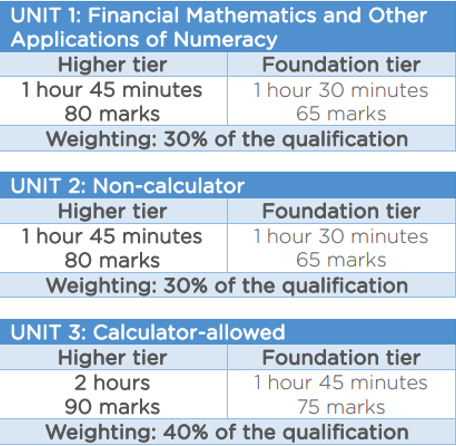
The course has 3 units:
UNIT 1: Financial Mathematics and Other Applications of Numeracy
In this unit you will learn life lessons that will help you become a financially well-informed adult. Think about terms or acronyms you may have heard about like ‘National Insurance’, ‘VAT’ or ‘AER’ – these will become familiar to you. Financial opportunities and pitfalls will be addressed, and you will learn how to read important documents like payslips, bills and bank statements. All sorts of other real-world contexts will also be taught and assessed, making this unit relevant and interesting.
UNIT 2: Non-calculator
You will explore concepts where you won’t need your calculator in this unit. You will deepen your understanding of probability and explore new ideas within algebra and geometry, like quadratic graphs and circle theorems.
UNIT 3: Calculator-allowed
This unit has the biggest weighting of all three units, and you can have your calculator by your side. There is lots of data handling and statistics in this unit as well as new geometry concepts such as Pythagoras’ Theorem and Trigonometry.
The course is available through the medium of English and Welsh.
This is a unitised qualification.
There are two tiers of entry for this qualification:
· Higher Tier: A*–D
· Foundation Tier: C–G
Learners may be entered at different tiers across units.
Skills
You will develop an understanding of the different areas of mathematics and how they relate to each other.
You will extend your range of mathematical skills and techniques and be able to use and apply them to a range of real-life contexts.
You will gain a strong foundation in financial mathematics to prepare you for life and work.
Careers in Mathematics
A GCSE in Mathematics and Numeracy can lead to a variety of career paths. These include jobs such as: financial analyst, computer programmer, medical scientist, actuary, software developer, economist, data or research analyst, accountant, teacher.
WJEC Course information
https://www.wjec.co.uk/qualifications/gcse-mathematics-and-numeracy-double-award-teaching-from-2025
WJEC Mathematics-Numeracy digital resources
https://filter.resources.wjec.co.uk/en/s/Mathematics%20and%20Numeracy
Examinations Body

Subject Leader
Mr S Williams